Is this the first glimpse of dark matter? Data point excites physicists
📌 概要
An image captured with the Hubble Space Telescope shows the distribution of dark matter in the center of the giant galaxy cluster. Credit: NASA/JPL-Caltech/ESA/IAA, University of Basque Country/JHU It
⚡ 关键要点
- ▸An image captured with the Hubble Space Telescope shows the
- ▸Enjoying our latest content?
- ▸Log in or create an account to continue
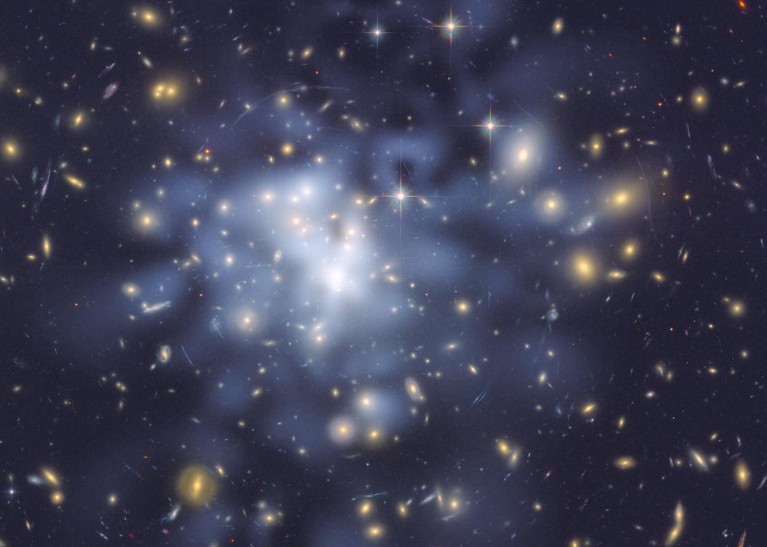
An image captured with the Hubble Space Telescope shows the distribution of dark matter in the center of the giant galaxy cluster.Credit: NASA/JPL-Caltech/ESA/IAA, University of Basque Country/JHU
It is a single data point, but enough to send a shiver down physicists’ spines. Some time in 2023 or 2024, a detector containing 10 tonnes of ultra-pure liquid xenon registered an unusual energetic flash. It was the type of signal that could be caused by a collision between an atom’s nucleus and a massive dark-matter particle as it passes through our Galaxy.
If the finding can be backed up with more data, it could mean that dark matter — the invisible stuff that is thought to keep galaxies from flying apart — has finally been discovered. And it would show that dark matter consists of particles much more massive than protons, namely the ‘weakly interacting massive particles’ (WIMPs) that have been theorized but remained undetected despite decades of searching.
Researchers working with the LUX-ZEPLIN (LZ) experiment at the Sanford Underground Research Facility in Lead, South Dakota, announced the result on 1 September at the TeV Particle Astrophysics conference in Tendo, Japan, and describe it in a preprint posted on the experiment's website1.
Previous experiments have seen hopeful signs of dark matter that turned out to be spurious, researchers warn. But LZ’s single outlier event “is intriguing, and will undoubtedly excite the field”, says Jianglai Liu, a physicist at Shanghai Jiao Tong University in China.
A high-energy event
For decades, theoreticians have posited that the prime component of dark matter is a WIMP. But attempts to detect the dark matter while it traverses the Earth, or to create it by smashing atoms at facilities such as the Large Hadron Collider (LHC) near Geneva, Switzerland, have come up empty. Many researchers turned their attention to other possible candidates, such as very light particles.
LZ, which started up in late 2021, is a scaled-up version of earlier experiments that aimed at the ‘direct detection’ of dark matter using xenon. In the study, Samuel Eriksen, the LZ researcher who presented the result at the Tendo conference, and his collaborators analysed 220 days of observational data taken from March 2023 to April 2024.
Crunch time for pet theory on dark matter
They focused on rare flashes that occur when a high-energy particle collides with a xenon nucleus, making it recoil at a high speed. “Typically, these searches focus on low energies, meaning less than 50 kiloelectronvolts of energy being deposited” onto the xenon nucleus, says Eriksen, a particle physicist at the University of Bristol, UK. “In this analysis, we extended that up to 270 keV.”
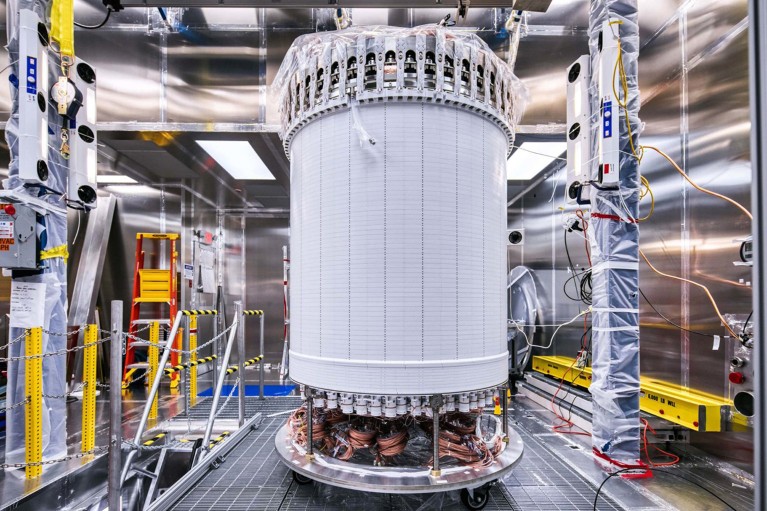
The LZ central detector at the Sanford Underground Research Facility in Lead, South Dakota.Credit: Matthew Kapust/Sanford Underground Research Laboratory
Both LZ and two competing series of experiments — XENON at Italy’s Gran Sasso National Laboratories and PandaX at the China Jinping Underground Laboratory in Sichuan — had conducted searches in this energy range before, says Eriksen. But they only could do so on smaller sets of data from earlier, smaller version of their detectors, and had found nothing beyond the expected background of spurious events, such as high-energy neutrons produced by background radiation.
To avoid its own biases, the LZ collaboration ‘salts’ its data during each analysis with numerous, randomly-produced events that mimic what dark-matter events would look like, says Richard Gaitskell, a physicist at Brown University and LZ spokesperson. Only when the researchers are done with a batch of data do they ‘unsalt’ it to see whether any remaining dark-matter signals were genuine.
“After we unsalted, there was a single event that was left,” says Gaitskell. “Obviously, that was very exciting.”
The ‘excess’ event was a recoil that deposited 248 keV of energy in the detector. The LZ researchers estimate that a dark-matter particle producing this recoil would have to weigh the equivalent of at least 200 gigaelectronvolts (GeV), and probably around 1,000 GeV (1 GeV corresponds roughly to the mass of a proton).
“What we observe is just one high-energy event,” says Eriksen. “We’re not claiming this is dark matter at all.”
Replicate this
“One thing is for sure: the event is very striking,” says Caterina Doglioni, an experimental particle physicist at the University of Manchester, UK, who works on the LHC’s ATLAS experiment at CERN, the European particle-physics laboratory.
Because the search focused on a less-well-explored region of the possible recoil energies, ruling out background “requires extreme caution”, says Liu, who is the spokesperson for PandaX. “Mundane explanations must be thoroughly investigated.”
Enjoying our latest content?
Log in or create an account to continue
- Access the most recent journalism from Nature's award-winning team
- Explore the latest features & opinion covering groundbreaking research
or
Sign in or create an account Continue with Google
 Continue with ORCiD